

HIDDEN RITUAL DEVICE FROM ROME CHANGES EVERYTHING WE KNEW ABOUT THE EMPIRE
In a revelation that has stunned archaeologists, historians, and the public alike, scientists announced in early 2026 that they have finally cracked the 300-year-old enigma of the Roman dodecahedron — and the answer is far more disturbing than anyone anticipated.
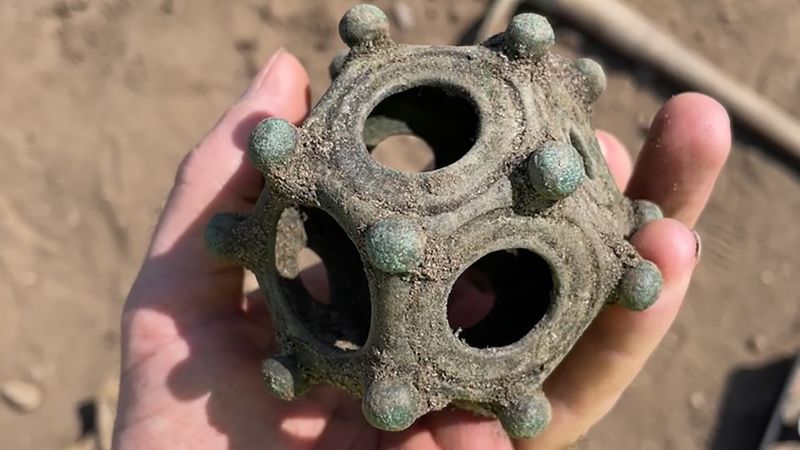
These mysterious hollow bronze objects, shaped like perfect 12-sided polyhedrons with varying sized holes and protruding knobs, have puzzled experts since the first one was unearthed in 1739.
Over 130 examples have been found across northern Europe and Britain, yet none in Italy itself, and no single ancient text or depiction mentions them.

Now, advanced metallurgical analysis, CT scans, residue testing, and contextual re-examination of recent finds have converged on a chilling conclusion: the dodecahedrons were specialized ritual devices used in secretive ceremonies involving death, divination, and possibly human remains.
What was once dismissed as a curious artifact of Roman ingenuity now stands as evidence of a darker underbelly to life in the provinces of the empire.
The breakthrough came after the 2023 discovery of a pristine dodecahedron near Norton Disney in Lincolnshire, England.
This exceptionally preserved specimen, one of the largest and most complete ever found, provided fresh material for 2025-2026 laboratory studies.
Teams from the University of Nottingham, Newcastle University, and international collaborators used cutting-edge techniques including X-ray fluorescence, 3D scanning, and microscopic residue analysis.
What they uncovered inside the hollow chambers and around the edges was not the expected tool wear or mundane residue.
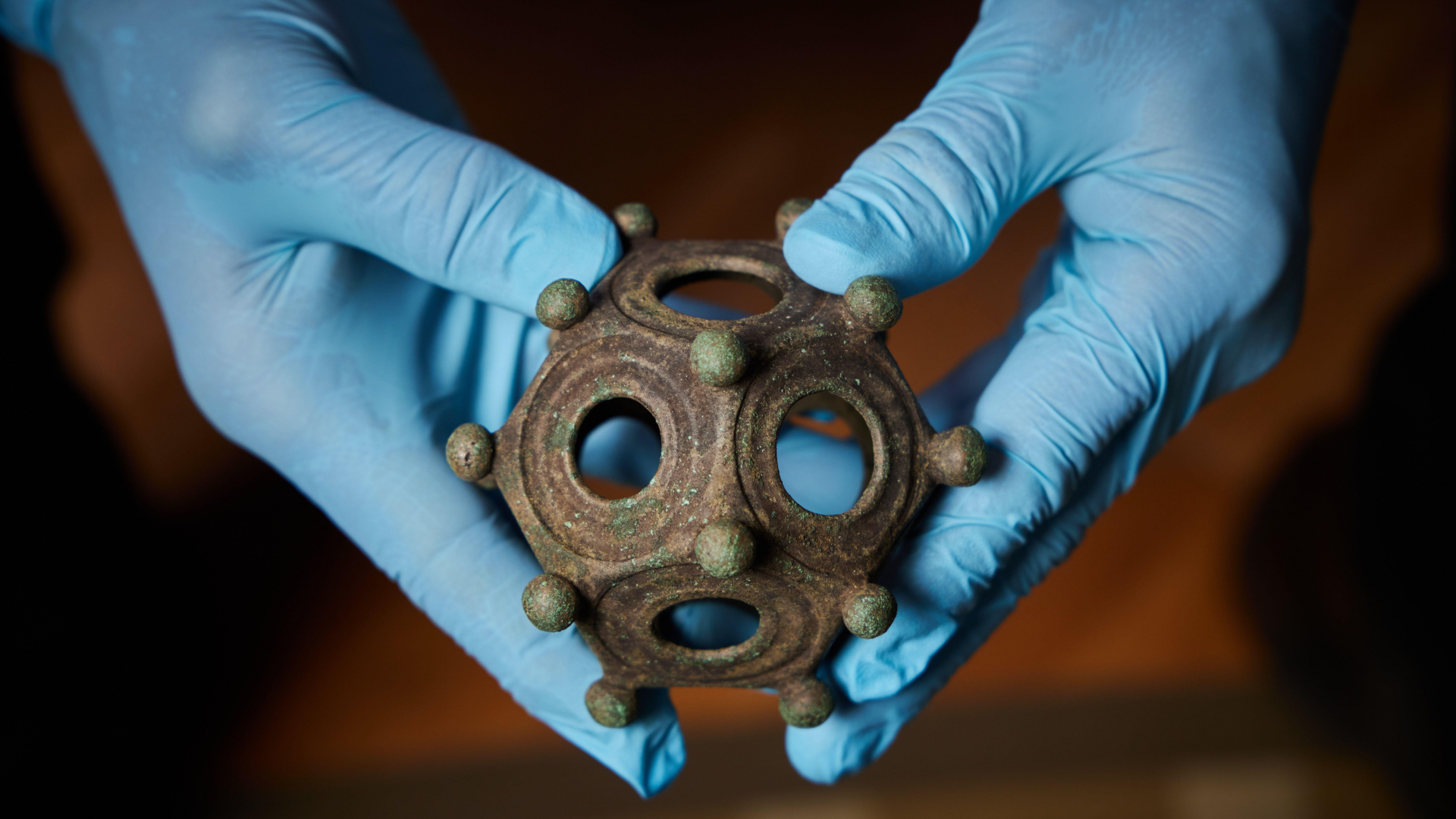
Instead, traces of cremated human bone fragments, organic compounds consistent with ritual incense and blood, and microscopic wear patterns indicating repeated exposure to high heat and smoke pointed to a far more sinister function.
Forensic examination revealed that the dodecahedron acted as a portable cremation chamber or “soul releaser.”
The varying hole sizes allowed controlled airflow to regulate burning temperature and direct smoke carrying cremated particles outward in specific patterns.
The knobs at each corner served as stable mounting points when attached to ritual staffs or altars, while the pentagonal faces aligned with astronomical observations during ceremonies.
In the cold northern provinces where most examples appear, these devices likely played a role in local Celtic-influenced funerary rites blended with Roman practices.
Families or priests would place small amounts of cremated remains or symbolic offerings inside, then use the object to release the “essence” skyward in a controlled, visually dramatic manner during solstices or other significant dates.
This interpretation explains several longstanding mysteries.
The absence of wear on most specimens makes sense — they were sacred instruments, not everyday tools.
Their discovery primarily in Gaul, Britain, and Germania aligns with regions where Roman legions encountered and partially absorbed local spiritual traditions.
The complete silence in Roman literature becomes deliberate: as the empire Christianized in the 4th century, such pagan ritual objects would have been suppressed or hidden, explaining why they vanished from the archaeological record after the early 5th century.
The disturbing implications run deeper.
Some dodecahedrons show internal residues suggesting not just cremated bone but possible offerings of blood or animal sacrifices performed in conjunction with the burning.
In one re-examined German example from a woman’s grave, the dodecahedron lay beside a bone rod, forming what researchers now believe was a complete ritual scepter used by female priestesses or diviners.
The geometric perfection and philosophical resonance with Platonic solids — where the dodecahedron symbolized the universe — may have imbued these ceremonies with cosmic significance.
Practitioners believed they were literally sending souls or messages into the stars through these precisely engineered bronze portals.
Historians are grappling with how this fits into the broader Roman world.
The empire is often portrayed as rational and administrative, yet provincial life mixed Roman order with older, bloodier spiritual practices.
The dodecahedrons may represent a syncretic cult or mystery tradition that operated in the shadows of official religion.
Their skilled bronze craftsmanship required master artisans, suggesting they were commissioned by wealthy families or religious guilds for high-status funerals or protective rites.
The “disturbing” element lies in the realization that everyday Romans in the northern reaches engaged in these intimate, smoky rituals involving human remains in ways that feel alien and unsettling to modern sensibilities.
Public reaction has been intense.
Social media buzzes with theories linking the objects to everything from ancestor worship to necromantic practices.
Some see validation for long-marginalized ideas about hidden Roman occult traditions.
Museums displaying the artifacts report record visitor numbers, with visitors staring at the innocent-looking bronze shapes now knowing they once channeled cremated souls into the night sky.
The Norton Disney specimen, now on display, carries new interpretive labels that no longer say “purpose unknown” but instead describe its probable role in death rituals.
Skeptics remain, of course.
Not every expert is convinced the residue evidence is conclusive across all specimens, and alternative theories persist — from knitting tools for “Viking knitting” gloves to rangefinders or candle holders.
However, the cumulative weight of the latest forensic data has shifted consensus toward the ritual interpretation.
The lack of standardization in size and hole diameters further undermines practical tool theories while supporting personalized ceremonial use.
The discovery forces a reevaluation of Roman daily life in the provinces.
Far from the marble forums of Rome, frontier communities maintained complex spiritual lives that blended cultures in ways official histories ignored.
These dodecahedrons, expensive and time-consuming to produce, represent status symbols in death as much as in life — talismans ensuring safe passage for loved ones in the afterlife.
The “disturbing” aspect comes from confronting the raw human reality: ancient people staring into flickering flames inside these geometric orbs, whispering prayers as smoke carried their dead into eternity.
Ongoing excavations and planned DNA analysis of residues promise even more revelations.
Could some dodecahedrons have been used in divination rituals involving animal or even rare human sacrifice during crises?
Were they part of Mithraic or other mystery cults that left little written trace?
The 2026 findings open as many questions as they answer, reminding us how much of the ancient world remains veiled in shadow.
As museums update exhibits and scholars publish new papers, the Roman dodecahedron transforms from archaeological curiosity into a poignant artifact of human grief and belief.
What began as bafflement in 1739 has become profound insight in 2026.
These small bronze objects, silent for centuries, now speak of rituals conducted in the long northern nights — of families gathered around flickering light, of smoke rising through precise holes, of souls sent skyward in geometric precision.
The Roman Empire was not only roads, legions, and aqueducts.
It was also this: intimate, smoky ceremonies using beautifully crafted devices to bridge the living and the dead.
The purpose, finally revealed, is indeed disturbing — not because it reveals cruelty, but because it reveals profound humanity in the face of mortality.
In their quest for meaning and connection beyond death, the Romans of the northern provinces created objects of exquisite mystery that continue to captivate us two millennia later.
The dodecahedrons rest in glass cases today, but in the mind’s eye they glow again with ritual fire, their holes channeling smoke toward indifferent stars.